



My theology builds on a pyramid. I honestly don’t know if it is a typical pyramid with the foundation resting firmly on the ground, or if the point is so integral and diamond-strong that the pyramid rests upside down on it. Here is my theology in a nutshell:
In the beginning was the Word, who said, “Let there be light,” and there was light! And the darkness cannot overcome the light.
The Word also said, ‘Let people be created. In My likeness they shall be created.” Thus, men and women were created. We have minds to think, wills to decide, and bodies to act. Plus, Jesus died for us so that we can also have His heart to love others.
We can choose kindness and love, blessing and grace because we are created in the image and likeness of God. All have dignity being created in His image.
It’s so simple.
However, life complicates my theology. My nice, simple way of thinking. Life gets messy. Free will leads to consequences for our actions.
Maybe something small challenges our choices. A bad night of sleep. A lost check. A misunderstanding with a loved one. Yet another meeting to attend. Slippery roads and a tough morning commute. These everyday clashes mess up our well-planned days. Perhaps something big challenges our dignity. A medical diagnosis, broken relationship, job layoff, or a visit from ICE. These wear away the hope God offers us and try to degrade the dignity we have in God’s image.
Nothing ever can erase our dignity as creatures made in God’s image and likeness. Although easy answers do not exist, I find aging offers perspective and grace. Like a tug-of-war, I hold sadness and hope inside at the same time. Tension between pain and joy, too, can live gracefully within.
Self-compassion is a powerful tool for navigating life’s tension, messiness, and suffering. Dr. Kristin Neff designed this model and writes:
Things will not always go the way we want them to. You will encounter frustrations, losses will occur, you will make mistakes, bump up against your limitations, and fall short of your ideals. This is the human condition, a reality shared by all. The more you open to this reality and work with it instead of constantly fighting against it, the more you will be able to feel compassion for yourself and your fellow humans in the experience of life.”
Dr. Kristin Neff
Compassion means “to suffer with,” relating to the root word for “patient.” As a nurse, I often suffered with my patients, listening to their fears. As a spiritual director, I listen to people’s sorrows and regrets.
The idea of self-compassion flows from secular psychology. It meshes well with Jesus’ command to “Love your neighbor as yourself.” Many times, I’ve sat with people in pain who needed self-compassion to make it through the day. I can walk them through a simple exercise to recognize their pain and acknowledge they are part of the human race (everyone suffers) and choose to treat themselves as a loved friend. Self-compassion increases one’s ability to love others. As I honor myself with kindness and mercy, I realize everyone needs kindness and mercy. We all suffer from big or little bumps and bruises. Let’s be people who raise the level of love in the world.
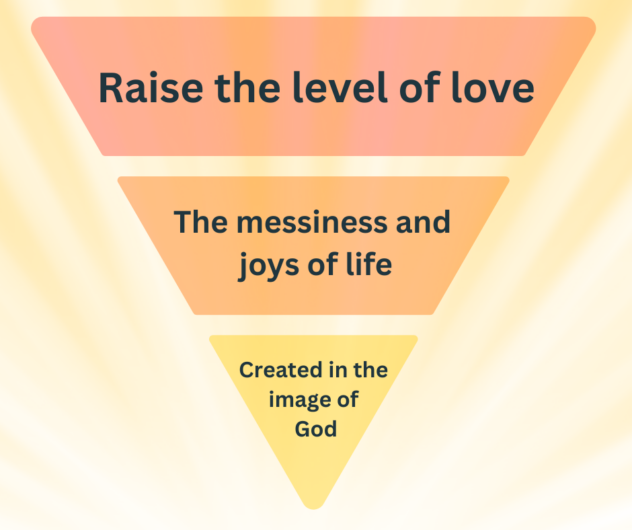
As we walk with one another, remember to uphold our human dignity, made in the image and likeness of God. It all rests on this. I’d say the pyramid is upside down.
mary.meeds@dunrovin.org | 651-433-2486